
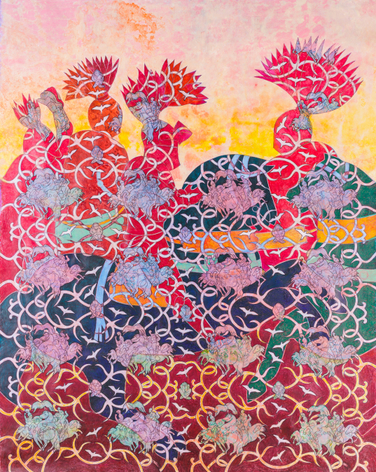
Roya Akhavan Shahabi
Birds, 2024
Acrylic on Linen
63.77 x 51.18 in | 162 x 130 cm
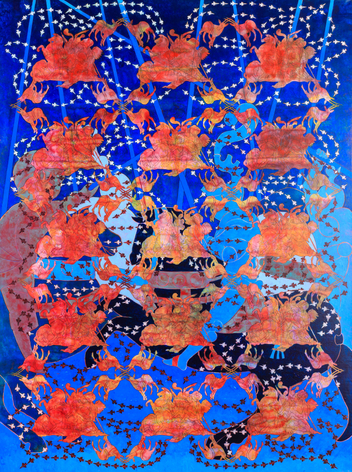
Roya Akhavan Shahabi
Peril, 2021
Acrylic on Linen
78.74 x 58.66 in | 200 x 149 cm
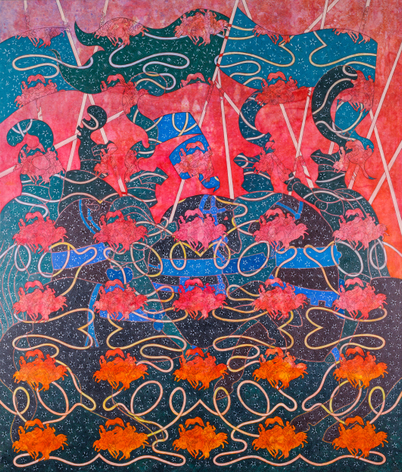
Roya Akhavan Shahabi
Veil, 2022
Acrylic on Linen
78.74 x 66.92 in | 200 x 170 cm
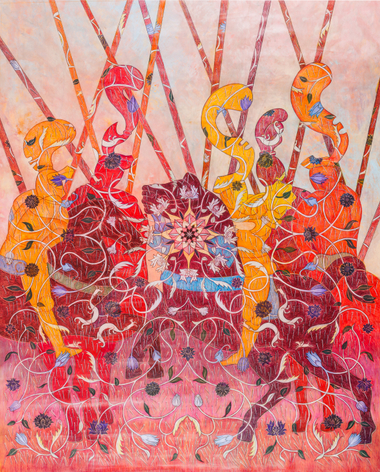
Roya Akhavan Shahabi
Raining Nails, 2024
Acrylic on Linen
63.78 x 51.18 in | 162 x 130 cm
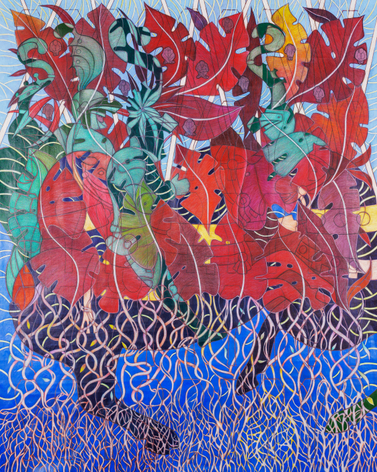
Roya Akhavan Shahabi
Uprooted, 2024
Acrylic on Linen
63.78 x 51.18 in | 162 x 130 cm
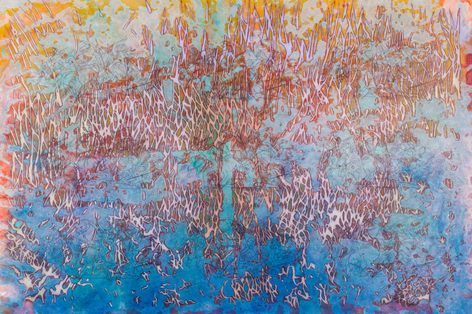
Roya Akhavan Shahabi
Listen to the Reed, 2022
Acrylic on Linen
57.48 x 38.18 in | 146 x 97 cm
Hybrid figures emerge throughout Roya Akhavan’s work, hovering between vegetal, animal, and symbolic states. These forms resist fixed identity, echoing natural processes in which boundaries remain fluid and porous. Interlacing lines weave through the compositions like roots, neural pathways, or migratory routes, acting as connective tissue that binds individual elements into larger, interdependent systems. Akhavan’s paintings represent an underlying map of relationships that sustains visible form.
Roya Akhavan’s work explores repetition as a living, generative force. Across layered compositions filled with recurring forms, intricate linework, and bold colors, her paintings investigate how organic life—plants, animals, bodies, and ecosystems—interacts with systems of order, memory, and ritual. Motifs repeat but never resolve into sameness; instead, each iteration shifts subtly, suggesting growth, mutation, and the passage of time.
Color plays a vital role in shaping the emotional and conceptual terrain of her work. Vibrant reds and oranges evoke vitality, heat, and life force, while expansive blues introduce depth, distance, and a sense of the infinite. The tension between these palettes mirrors a broader dialogue within her paintings: energy versus containment, freedom versus structure, chaos versus order.
Drawing from both natural and imagined worlds, Akhavan’s practice reflects on how systems—ecological, social, and cosmological—shape living beings, and how those beings, in turn, reshape the systems they inhabit. Her work invites sustained looking, encouraging viewers to trace patterns, follow lines, and recognize repetition not as stasis, but as transformation in motion.